
Stock market is gearing up for an eventful week ahead where key triggers such as quarterly earnings from corporates, the US Fed interest rate decision and the upcoming Union Budget for 2026-27 would grab the limelight, analysts said.

Falling for the second consecutive week, India's forex reserves dropped by $4.34 billion to $589.14 billion for the week ended May 26, the Reserve Bank said on Friday. In the previous reporting week, the reserves had declined by $6.05 billion to $593.48 billion. It can be noted that in October 2021, the country's forex kitty had reached an all-time high of $645 billion.

Foreign currency assets, a major component of the overall reserves, declined by $3.208 billion to $395.276 billion.

'In the long run, India's strong growth story and reforms to make assets globally attractive will determine the rupee's resilience.'
The rupee on Friday breached the psychological 47-mark after six-and-a-half months on heavy dollar outflow, but ended the day with a marginal fall of 15 paise against the American currency at 46.96/97.

FCAs decreased by $3.56 billion to $325.03 billion.

Foreign exchange reserves of eight Asian countries have depleted by a record $36 billion in August alone, as foreign investors pulled out money and central banks were seen using the reserves to prop up falling local currencies.
Country's foreign exchange reserves dropped by $2.063 billion to $ 335.729 billion in the week to March 13.

Last week, the forex reserves had surged by $2.374 billion to $363.171 billion.

The rupee breached 90-levels against the greenback for the first time on Wednesday, falling 6 paise to 90.02 in early trade, as banks kept buying US dollars at higher levels and FII outflows continued.

Importers are rushing to hedge their dollar positions amid the sharp depreciation of the rupee against the American currency and expectations of further volatility even as exporters are holding off after suffering mark-to-market (MTM) losses on earlier hedges.
Lower international interest rates during June-July 2002-03 led to a sharp fall in returns on India's foreign currency assets to 2.8 per cent compared to 4.1 per cent during FY02 while that on gold reserves it fell to 0.6 per cent from 0.9 per cent.

India's foreign exchange reserves dropped $325 million to $560.942 billion as of February 24, making it the fourth consecutive week of decline in the kitty, the Reserve Bank of India said on Friday. In the previous reporting week, the overall reserves had declined $5.68 billion to $561.267 billion. In October 2021, the forex kitty reached an all-time high of $645 billion.

In response to the panic triggered by Trump's trade policies, the RBI net sold approximately $43 billion in the second half of FY25 to curb volatility, as the rupee plunged to a low of 87.95 per dollar in February this year.

'Investors can consider staying invested in long duration products as there is a possibility of rate cuts in the near term.' Positive macros - lower inflation, high forex reserves and favourable demand-supply dynamics for government bonds - make a strong case for rate cuts from December, says Devang Shah, head of fixed income, Axis Mutual Fund. In an interview with Abhishek Kumar in Mumbai, Shah says this view may not hold true if commodity prices go up sharply.

The recent depreciation of the rupee along with sharp fall in the country's foreign exchange (FX) reserves has sparked a debate whether stability of the exchange rate is necessary and desirable. The rupee was one of the least volatile currencies among peers for almost two years before the current downward pressure started in September after the US Federal Reserve lowered interest rate.

The rising price of the precious metal has helped the central bank increase overall forex reserves despite currency reserves not rising, and sometimes even falling.

'If it doesn't, it will continue with measures to infuse liquidity, signalling a new cycle,' predicts Tamal Bandyopadhyay.
As the nosediving rupee shatters foreign-education dreams and eats away the country's much-vaunted forex reserves -- to mention just two fallouts -- Uttam Ghosh takes up pen and paper to outline what the common Indian is feeling.

With inflation remaining at elevated levels, central banks around the world, including the Reserve Bank of India (RBI), will kill excess demand in economy over the next six to eight months, sources in the know said. They also indicated that there could be a rate hike in June, when the inflation forecast for the current financial year would be raised. The RBI, the sources said, might announce more steps such as raising the limit on held-to-maturity (HTM) bonds to support government borrowings but might not come out with any further quantitative easing GSAP (Government Securities Acquisition Programme) measures.

The Budget should undertake further reductions in import tariffs and seriously consider an announcement of India's intention to join one or both of the two Asian mega-regional free trade agreements, suggests Shankar Acharya, former chief economic adviser to the Government of India.

Caution ahead of key consumer inflation data in the day also weighed.

Escalating trade tensions amid a tariff war after Donald Trump took over as President of the United States (US) could adversely impact global growth and fuel inflation, an article on the "State of the Economy" in the Reserve Bank of India (RBI) monthly bulletin said.

While liquidity in the banking system has turned surplus in the last few weeks, it could go back to deficit again, mainly due to corporate advance tax outflows. The net liquidity surplus of the banking system rose to touch Rs 1 trillion on Tuesday on the back of government spending, according to the data released by the Reserve Bank of India.
After selling dollars for the past few months, the Reserve Bank of India (RBI) may take a hands-off approach before its annual account closing by not trying to prop up the rupee as geopolitical tensions show signs of stabilising with global crude oil prices easing from its $140 peak. The central bank was a net buyer of dollars between April and September, and then turned a net seller in the following months, the data released by the RBI showed. The RBI continued to be a net buyer of $36.6 billion in this fiscal year - between April and January. In 2020-21, it purchased $68 billion on a net basis.

The rupee fell 1.87 percent against the dollar this week, its biggest fall since late April.
.jpg)
The BofAML report said that five year money can be raised by issuing the 7 to 9 per cent coupon bonds to stabilise markets, just as it was done in 1998 and 2001.

Already retail inflation has risen to 6.07 per cent in February, crossing the upper band of the Parliamentary mandate. This is the second consecutive month in 2022 when retail inflation has crossed the 6 per cent mark having hit 6.01 per cent in January.

ICICI Bank chief Chanda Kochhar on Wednesday said the country has many positives like high forex reserves, and low current account and fiscal gaps, which can help it weather the ongoing volatilities.
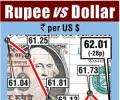
The RBI is widely expected to raise its key repo rate by 25 basis points to 8.00 per cent on Wednesday, its third such hike in four months after recent data showed both wholesale and retail inflation at multi-month highs.
The rupee depreciated 31 paise to an all-time low of 80.15 against the US dollar in early trade on Monday tracking the strength of the American currency and firm crude oil prices. At the interbank foreign exchange, the rupee opened at 80.10 against the dollar, then lost ground to quote at 80.15, registering a fall of 31 paise from the last close. On Friday, the rupee closed at 79.84 against the dollar.

The report, however, said a sustained weakness in USD against the emerging market forex remains a key risk to this view.

The Reserve Bank of India (RBI) will have to take far more pro-active steps to rebuild forex reserves, because if the status quo remains, rupee could touch 75 per US dollar by the end of 2014, Bank of America Merrill Lynch said in a report.

The finance ministry on Monday said the ability of the Reserve Bank to intervene in the forex market to arrest the fall in rupee is limited, even as the Indian currency declined to a 32-month low of Rs 51.50 per US dollar in the early trade.

Falling for the second day, the rupee on Thursday weakened by 14 paise to close at 54.46 tracking losses in Indian stocks amid sustained dollar demand from importers.
The rupee depreciated by 37 paise to close at 79.62 against the US dollar on Thursday despite sustained foreign capital inflows and a positive trend in equities. At the interbank foreign exchange market, the local currency opened at 79.22 and saw an intra-day high of 79.22 and a low of 79.94 against the American currency. It finally ended at 79.62, down 37 paise over its previous close of 79.25.

Business is down to such an extent that last year these firms could not even meet RBI's capital norm of Rs 50 million for partnerships and Rs 100 million for public and private firms in this line of business.

The RBI opened a forex swap window in August to meet the entire daily dollar requirements of three oil marketing companies as the rupee depreciated to an all-time low of 68.85 against the US currency.
The rupee plunged to nearly 33-month low of sub-52 level after losing a whopping 81 paise against the United States currency on sustained dollar demand amid weak trends in stock markets and deepening euro-debt crisis.

It has been a choppy calendar year 2022 (CY22) for global financial markets amid the spectre of rising inflation that led most central banks, especially the US Federal Reserve (US Fed), to tighten their monetary policy. Most equity indices across the globe have seen a sharp fall from their respective peak levels in this backdrop. FTSE India, for instance, has corrected 16 per cent from its October peak.
